Horizontal panoramas are so 2009 -- which is why I now give you the vertical panorama:
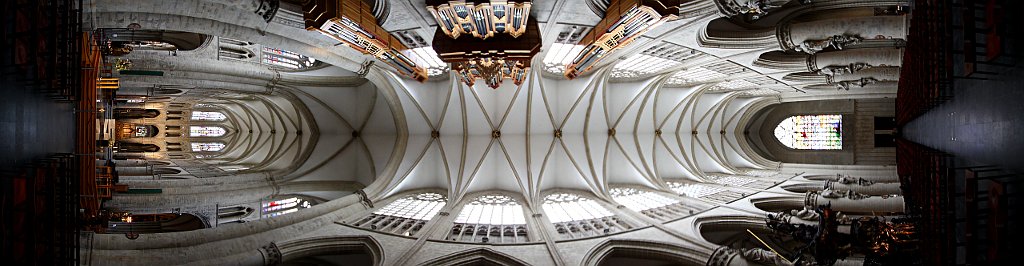
Now if I wasn't too stupid to hold my camera steady shooting upwards, this could actually have been a really good picture.
Horizontal panoramas are so 2009 -- which is why I now give you the vertical panorama:
Now if I wasn't too stupid to hold my camera steady shooting upwards, this could actually have been a really good picture.
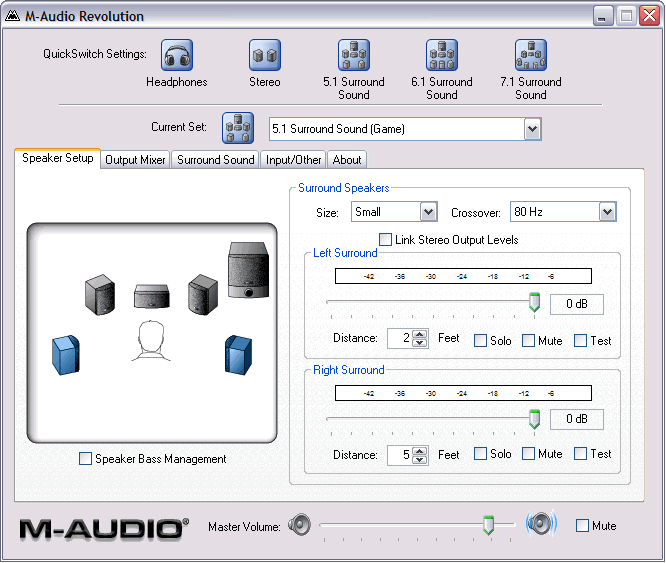
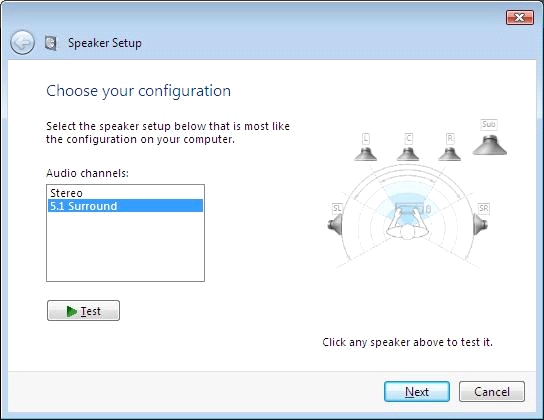
While tracking down some surround sound related bugs I was missing a speaker setup and testing utility. So I decided to do something about it and I present you gnome-speaker-setup:

The tool should be very robust and even deal with the weirdest channel mappings. OTOH the artwork is not really good and appropriate. But I hope it still shows some resemblance to other UIs of this type. If you are an artist wand want to contribute better artwork make sure to go through the Gnome Art Requests page, and more specifically this particular request.
This (or something like it) will hopefully and eventually end up in some way or another in gnome-media. Until that day comes I'll maintain this tool independently.
To compile this you need a recent Vala and libcanberra 0.23.
Here's the seventh and final part of my ongoing series.
One of the grandest sights in Delhi is Humayun's tomb, a predecessor of the greatest mausoleum of them all, the Taj Mahal:

A little bit further down a view on the garden:

From a different corner:

We'll finish with our last panorama that shows the courtyard the Jama Masjid of Old Delhi:

That's all panoramas from this trip. Thanks for your interest.
Here's the sixth part of my ongoing series.
Leaving Jodhpur we continued our journey to Jaisalmer, a sand castle of a town in the Thar desert:
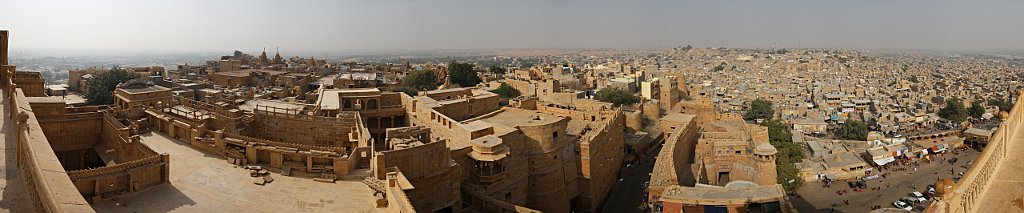
In the vicinity of Jaisalmer you'll find cliche sand dunes like you'd expect from a grown-up desert:

Our next station after a long, cold and dusty train ride was Delhi. The principal mosque of Old Delhi is the Jama Masjid:

That's all for now, tomorrow I'll post the rest of my panoramas from this trip, all from Delhi.
Here's the fourth part of my ongoing series.
After Udaipur the next stop on our trip was Jodhpur, the blue city. Which is called that way due of the blue colour of many of its houses:

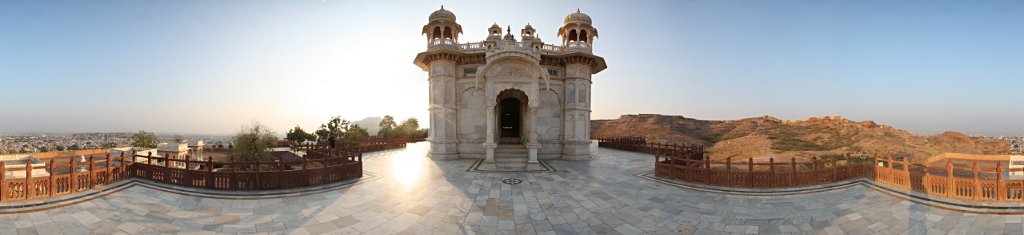
On a hill next to Mehrangarh Fort, one of the biggest Forts in India (the big sand castle on the hill in the panorama above), you find the Jaswant Thada, a memorial of the Maharajas of Jodhpur:
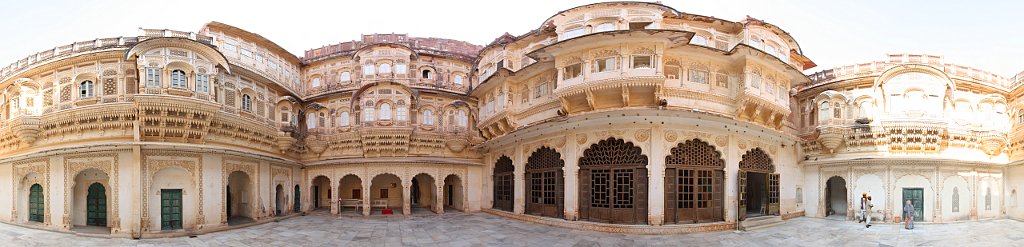
Inside the fort you'll find highly decorated courtyards:
That's all for Jodhpur, tomorrow I'll post more panoramas, from other stops of our trip.
Here's the fourth part of my ongoing series.
After Hampi we went to Bangalore to attend foss.in. (Fantastic conference, btw. The concerts at the venue are unparalleled.) From there we flew up to Udaipur, in Rajasthan. Udaipur is (among other things) famous for being the place where the central scenes of Octopussy were filmed. Octopussy's famous white palace is on Jagniwas Island in Lake Pichola:

This panorama was taken from another island in the lake, Jagmandir Island, which is visible in the following shot on the left:

Udaipur's scenery, seen from the Maharaja's City Palace down onto Pichola Lake:

That's all for Udaipur, tomorrow I'll post more panoramas, from other stops of our trip.
It's easy to get lost in /sys and not much fun typing long udevadm info command lines all the time. Today, when I had enough of that I sat down and spent an hour to write a little UI for exploring the udev/sysfs tree: udev-browse. I wrote it for my own use, but I am quite sure I am not the only one who wants a little bit simpler access to the device tree. So here you go.
And since everybody loves screenshots here you go:
Two usability hints: if you run udev-browse from a directory in /sys udev-browse will automatically present the device of that path on startup. And if you know the name of a device you can just type it into the device listbox (which is focussed by default). The usual Gtk+ live search will then find you the right entry right-away. It's pretty nifty.
It's written in Vala with minimal dependencies.
I want to keep the maintainership burden for this minimal. So no tarballs, no releases, and I won't reply to your emails regarding this tool, unless they include a good, clean, git formatted patch. Thank you for your understanding.
Anyone wants to package this for Fedora? I'd be very thankful if someone would pick it up.
Have fun.
Here's the third part of my ongoing series.
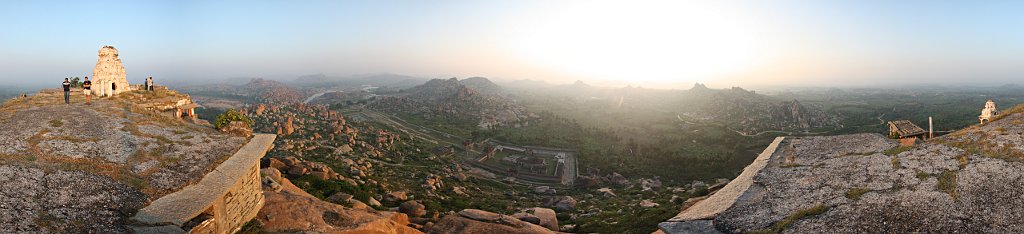
Still in Hampi here's another 360 from the Hills in Hampi down to the Achyutaraya Temple:
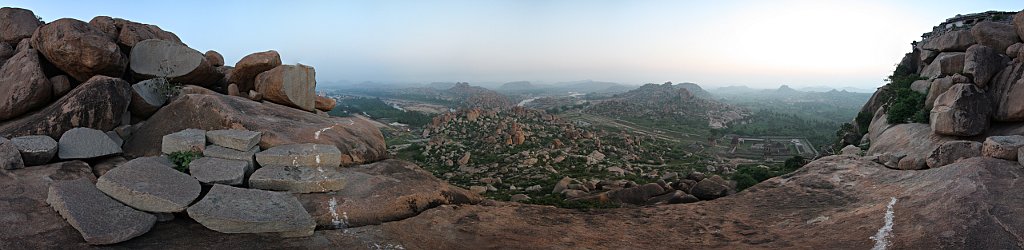
A little further down, before dawn, here's a shot from the rocky path leading up the hill:
Our last picture for today is a view down from Hemakuta Hill which is covered with old temples and other structures. In the middle you'll see the large Virupaksha Temple which is still in full use. In that temple you'll find an amazing camera obscura, a physics teacher's dream that projects the temple tower onto a wall (projection, subject, more interesting in reality. Really.)

That's all for Hampi, tomorrow I'll post more panoramas, from other stops of our trip.
Everyone and his dog seem to call libxml2's xmlCleanupParser() at inappropriate places. For example Empathy does it, and Abiword does it too. Google Code Search seems to reveal at least Inkscape and Dia do it as well.
So, please, if your project links against libxml2 verify that it calls xmlCleanupParser() only once, and right before exiting! And if it calls it more often or somewhere else, then please fix that!
For more information see my post on fedora-devel.
Thanks for your time.
Here's the second part of my ongoing series.
Climbing down the hills, on the banks of the Tungabhadra river you find people washing laundry and bathing, and coracles waiting to be used for a trip through the river.

The greatest of the ancient temples in Hampi is the Vitthala Temple:

Set in in lush green scenery you find the Achyutaraya Temple, which you already might have seen, from above, in yesterday's series:

That's it for today, tomorrow I'll post more panoramas, both from Hampi and other stops of our trip.